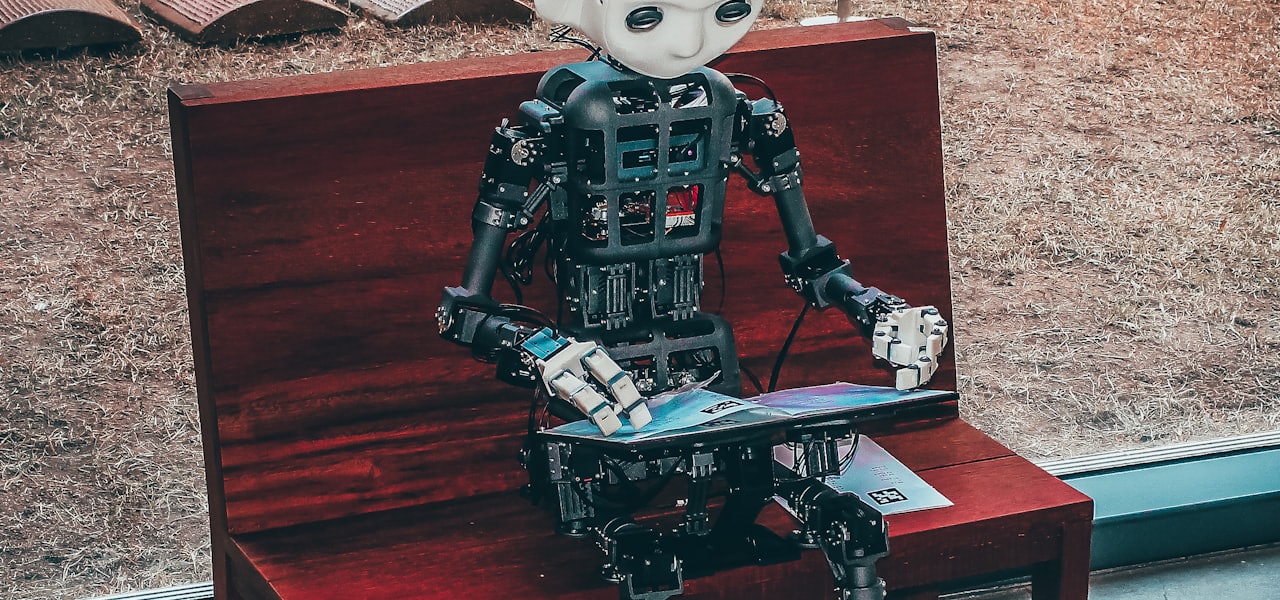
Business process automation (BPA), also known as business automation, refers to the technology-enabled automation of business processes. == Development approaches == There are three main approaches to developing BPA: traditional business process automation involves developing BPA software in a programming language for integrating relevant applications in the digital ecosystem to execute a given process; robotic process automation uses software robots (also called agents, bots, or workers) to emulate human-computer interaction for executing a combination of processes, activities, transactions, and tasks in one or more unrelated software systems; hyperautomation (also called intelligent automation (IA), intelligent process automation (IPA), integrated automation platform (IAP), and cognitive automation (CA) combines business process automation, artificial intelligence (AI), and machine learning (ML) to discover, validate, and execute organizational processes automatically with no or minimal human intervention. == Deployment == BPA toolsets vary in capability. With the increasing adoption of artificial intelligence (AI), organizations are implementing AI-driven technologies that can process natural language, interpret unstructured datasets, and interact with users. These systems are designed to adapt to new types of problems with reduced reliance on human intervention. == Business process management implementation == A business process management system differs from BPA. However, it is possible to implement automation based on a BPM implementation. The methods to achieve this vary, from writing custom application code to using specialist BPA tools. == Robotic process automation == Robotic process automation (RPA) involves the deployment of attended or unattended software agents in an organization's environment. These software agents, or robots, are programmed to perform predefined structured and repetitive sets of business tasks or processes. Robotic process automation is designed to streamline workflows by delegating repetitive tasks to software agents, allowing human workers to focus on more complex and strategic activities. BPA providers typically focus on different industry sectors, but the underlying approach is generally similar in that they aim to provide the shortest route to automation by interacting with the user interface rather than modifying the application code or database behind it. == Use of artificial intelligence == Artificial intelligence software robots are used to handle unstructured data sets (like images, texts, audios) and are often deployed after implementing robotic process automation. They can, for instance, generate an automatic transcript from a video. The combination of automation and artificial intelligence (AI) enables autonomy for robots, along with the capability to perform cognitive tasks. At this stage, robots can learn and improve processes by analyzing and adapting them.
International Road Traffic and Accident Database
The International Road Traffic and Accident Database (IRTAD) is an initiative dedicated to compiling and analyzing global road crash data. It is managed by the International Transport Forum (ITF) under the auspices of its permanent working group, which specializes in road safety, commonly referred to as the IRTAD Group. The primary objective of IRTAD is to provide a robust empirical basis for international comparisons in the field of road safety and to offer data to support the formulation of effective road safety policies. == Data availability == A portion of the data gathered by IRTAD is accessible for free through the OECD statistics website, however the remaining data requires a subscription for access. == History == The IRTAD database was originally started in 1988 by Germany's Federal Institution for Roads (BASt) in response to demands for international comparative data. It was later taken over and expanded by the International Transport Forum and has grown to be an important resource for comparing road safety metrics between countries worldwide, although mostly in the developed world. Every year, the ITF publishes comparative and country-by-country road safety data gathered for the IRTAD database and analysed by the IRTAD Group in the ITF Road Safety Annual Report, informally known as "IRTAD Report". Over the years, the IRTAD acronym has come to stand not only for the database, but also for the Traffic Safety Data and Analysis Group (usually referred to as IRTAD Group). The IRTAD Group is the International Transport Forum's permanent working group on road safety. It consists of a group of international road safety experts drawn from national road administrations, road safety research institutes, International organizations, automobile associations, insurance companies, car manufacturers and other road safety stakeholders. The IRTAD Group is a major forum for international road safety collaboration and exchange of best practices. Its focus is on improving road safety data as a basis for targeting interventions that are effective in reducing the number of road deaths and serious traffic injuries. The work of IRTAD, among that of others, has spawned the creation of road safety observatories for different world regions: the Ibero-American Road Safety Observatory Archived 2020-06-28 at the Wayback Machine (OISEVI), the African Road Safety Observatory Archived 2020-06-10 at the Wayback Machine, and the South-East Asian Road Safety Observatory. The ITF supports OISEVI through the Spanish-language IRTAD-LAC database and is actively involved in the implementation of the African and South East-Asian observatories. The genesis of the road safety observatory movement dates back to 2008, when the ITF, via IRTAD, began to facilitate twinning between countries striving to improve their road safety record and countries with high road safety performance. The initial twinning was between Jamaica and the United Kingdom. This work was supported by the World Bank, the Inter-American Development Bank (IADB) and the FIA Foundation. The twinning between Argentina and Spain in 2011 led to the creation of OISEVI. To this day, the ITF supports OISEVI through the Spanish-language IRTAD-LAC database. In 2006, the ITF set up Safer City Streets, a global traffic safety network for cities that replicates the successful IRTAD approach for urban road safety.
Circular thresholding
Circular thresholding is an algorithm for automatic image threshold selection in image processing. Most threshold selection algorithms assume that the values (e.g. intensities) lie on a linear scale. However, some quantities such as hue and orientation are a circular quantity, and therefore require circular thresholding algorithms. The example shows that the standard linear version of Otsu's method when applied to the hue channel of an image of blood cells fails to correctly segment the large white blood cells (leukocytes). In contrast the white blood cells are correctly segmented by the circular version of Otsu's method. == Methods == There are a relatively small number of circular image threshold selection algorithms. The following examples are all based on Otsu's method for linear histograms: (Tseng, Li and Tung 1995) smooth the circular histogram, and apply Otsu's method. The histogram is cyclically rotated so that the selected threshold is shifted to zero. Otsu's method and histogram rotation are applied iteratively until several heuristics involving class size, threshold location, and class variance are satisfied. (Wu et al. 2006) smooth the circular histogram until it contains only two peaks. The histogram is cyclically rotated so that the midpoint between the peaks is shifted to zero. Otsu's method and histogram rotation are applied iteratively until convergence of the threshold. (Lai and Rosin 2014) applied Otsu's method to the circular histogram. For the two class circular thresholding task they showed that, for a histogram with an even number of bins, the optimal solution for Otsu's criterion of within-class variance is obtained when the histogram is split into two halves. Therefore the optimal solution can be efficiently obtained in linear rather than quadratic time. == References and further reading == D.-C. Tseng, Y.-F. Li, and C.-T. Tung, Circular histogram thresholding for color image segmentation in Proc. Int. Conf. Document Anal. Recognit., 1995, pp. 673–676. J. Wu, P. Zeng, Y. Zhou, and C. Olivier, A novel color image segmentation method and its application to white blood cell image analysis in Proc. Int. Conf. Signal Process., vol. 2. 2006, pp. 16–20. Y.K. Lai, P.L. Rosin, Efficient Circular Thresholding, IEEE Trans. on Image Processing 23(3), 992–1001 (2014). doi:10.1109/TIP.2013.2297014
Fuse Mediation Router
Fuse Mediation Router is an open source tool for integrating services using Enterprise Integration Patterns based on Apache Camel for use in enterprise IT organizations. It is certified, productized and fully supported by the people who wrote the code. Fuse Mediation Router uses a standard method of notation to go from diagram to implementation without coding. Fuse Mediation Router is a rule-based routing and process mediation engine that combines the ease of basic POJO development with the clarity of the standard Enterprise Integration Patterns. It can be deployed inside any container or be used stand-alone, and works directly with any kind of transport or messaging model to rapidly integrate existing services and applications. Fuse Mediation Router is now a part of Red Hat JBoss Fuse. == Tooling == FuseSource offers graphical, Eclipse-based tooling for Apache Camel for download.
Cooperative storage cloud
A cooperative storage cloud is a decentralized model of networked online storage where data is stored on multiple computers (nodes), hosted by the participants cooperating in the cloud. For the cooperative scheme to be viable, the total storage contributed in aggregate must be at least equal to the amount of storage needed by end users. However, some nodes may contribute less storage and some may contribute more. There may be reward models to compensate the nodes contributing more. Unlike a traditional storage cloud, a cooperative does not directly employ dedicated servers for the actual storage of the data, thereby eliminating the need for a significant dedicated hardware investment. Each node in the cooperative runs specialized software which communicates with a centralized control and orchestration server, thereby allowing the node to both consume and contribute storage space to the cloud. The centralized control and orchestration server requires several orders of magnitude less resources (storage, computing power, and bandwidth) to operate, relative to the overall capacity of the cooperative. == Data security == Files hosted in the cloud are fragmented and encrypted before leaving the local machine. They are then distributed randomly using a load balancing and geo-distribution algorithm to other nodes in the cooperative. Users can add an additional layer of security and reduce storage space by compressing and encrypting files before they are copied to the cloud. == Data redundancy == In order to maintain data integrity and high availability across a relatively unreliable set of computers over a wide area network like the Internet, the source node will add some level of redundancy to each data block. This allows the system to recreate the entire block even if some nodes are temporarily unavailable (due to loss of network connectivity, the machine being powered off or a hardware failure). The most storage and bandwidth efficient forms of redundancy use erasure coding techniques like Reed–Solomon. A simple, less CPU intensive but more expensive form of redundancy is duplicate copies. == Flexible contribution == Due to bandwidth or hardware constraints some nodes may not be able to contribute as much space as they consume in the cloud. On the other hand, nodes with large storage space and limited or no bandwidth constraints may contribute more than they consume, thereby the cooperative can stay in balance.
XLNet
The XLNet was an autoregressive Transformer designed as an improvement over BERT, with 340M parameters and trained on 33 billion words. It was released on 19 June 2019, under the Apache 2.0 license. It achieved state-of-the-art results on a variety of natural language processing tasks, including language modeling, question answering, and natural language inference. == Architecture == The main idea of XLNet is to model language autoregressively like the GPT models, but allow for all possible permutations of a sentence. Concretely, consider the following sentence:My dog is cute.In standard autoregressive language modeling, the model would be tasked with predicting the probability of each word, conditioned on the previous words as its context: We factorize the joint probability of a sequence of words x 1 , … , x T {\displaystyle x_{1},\ldots ,x_{T}} using the chain rule: Pr ( x 1 , … , x T ) = Pr ( x 1 ) Pr ( x 2 | x 1 ) Pr ( x 3 | x 1 , x 2 ) … Pr ( x T | x 1 , … , x T − 1 ) . {\displaystyle \Pr(x_{1},\ldots ,x_{T})=\Pr(x_{1})\Pr(x_{2}|x_{1})\Pr(x_{3}|x_{1},x_{2})\ldots \Pr(x_{T}|x_{1},\ldots ,x_{T-1}).} For example, the sentence "My dog is cute" is factorized as: Pr ( My , dog , is , cute ) = Pr ( My ) Pr ( dog | My ) Pr ( is | My , dog ) Pr ( cute | My , dog , is ) . {\displaystyle \Pr({\text{My}},{\text{dog}},{\text{is}},{\text{cute}})=\Pr({\text{My}})\Pr({\text{dog}}|{\text{My}})\Pr({\text{is}}|{\text{My}},{\text{dog}})\Pr({\text{cute}}|{\text{My}},{\text{dog}},{\text{is}}).} Schematically, we can write it as
FlowVella
FlowVella (formerly Flowboard) is an interactive presentation platform that includes an iPad/iPhone app, a Mac app and web site for viewing presentations, built first for the iPad and web. FlowVella allows users to create, publish and share presentations through their cloud-based SaaS system. FlowVella allows embedding of text, images, PDFs, video and gallery objects in easy linkable screens, defining modern interactive presentations. FlowVella grew out of Treemo Labs. == History == FlowVella launched as 'Flowboard' on April 18, 2013 after being built for almost a year. FlowVella was incubated out of Treemo Labs, which had years of experience building native apps for iPhone, iPad and Android devices. FlowVella is an iPad app and Mac app where users create, view, publish and share interactive presentations. Presentations are viewable on flowvella.com through a web-based viewer on any device or through the FlowVella native iPad app or Mac app. On December 18, 2014, Flowboard rebranded as FlowVella after a trademark dispute. == Presentation format == FlowVella is an interactive presentation format where instead of single directional slides, presentations are made up of linkable screens with embeddable media and content objects. While 'Flows' can be exported to PDF, they all have a web address and are meant to be viewed via a web browser or the FlowVella native applications. == Revenue model == FlowVella uses the freemium model for its presentation apps. Free users can make 4 public presentations with limited number of screens/slides, but most features are available to try out the software. In 2016, FlowVella introduced a second paid plan called PRO which includes team sharing, tracking and newly introduced 'Kiosk Mode' that launched in March of 2017. == Features == FlowVella is a native iPad app and Mac app which has advantages over web based tools. All downloaded presentations can be viewed offline, without an Internet connection. This includes videos which are enabled by caching the video files into memory. For students, teachers, sales people and all users, this is extremely important because this prevents having a presentation fail because of lack of an Internet connection. Beyond the offline capabilities, there is a trend to build native applications versus HTML5 as noted by Facebook and LinkedIn both rebuilding their mobile apps as 100% native applications.